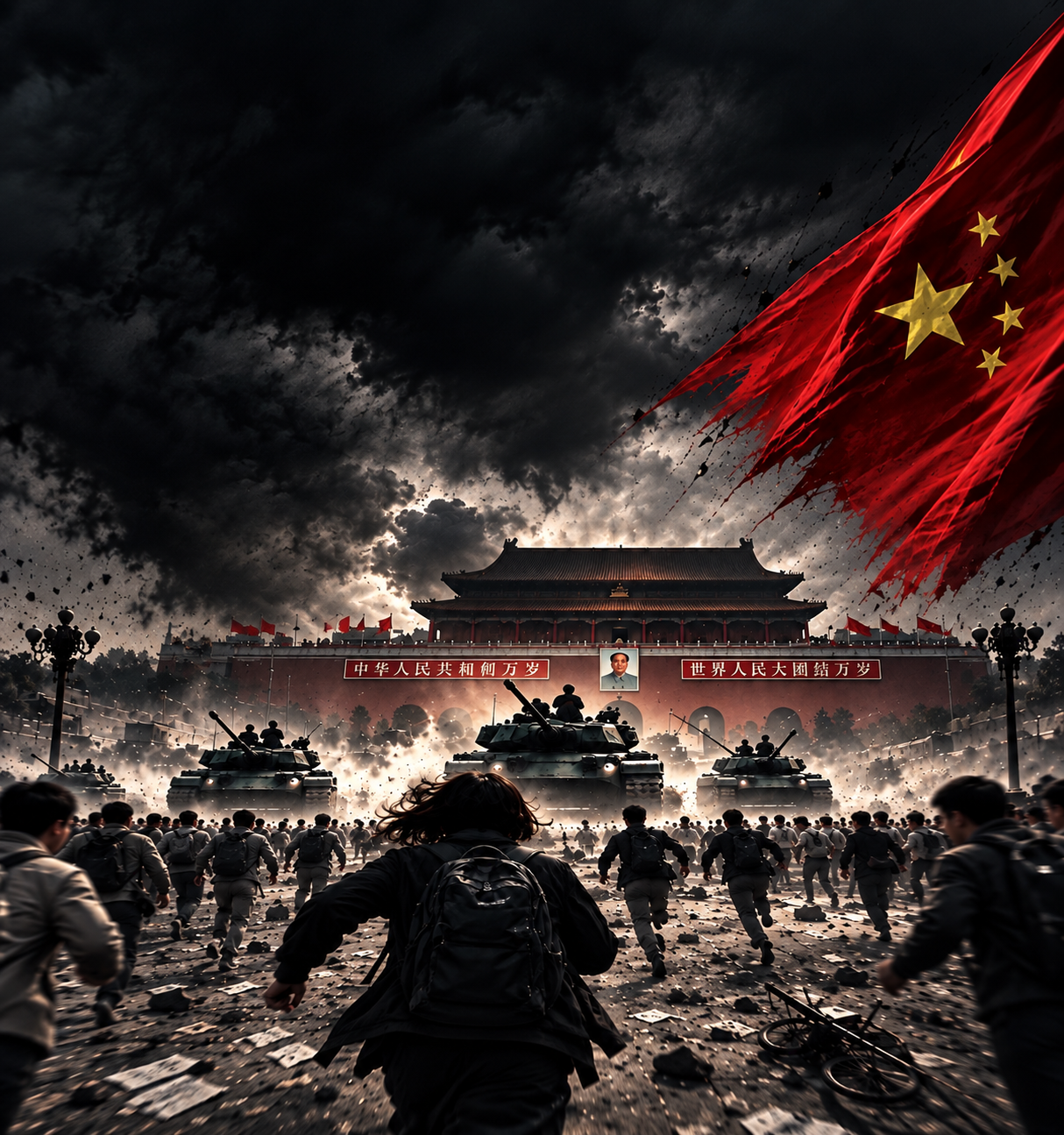
According to the material, on the night of June 4, the 38th Army and the 15th Airborne Army allegedly fired at civilians and students while advancing along the streets. At about 1:30 a.m., martial-law troops around Tiananmen Square allegedly opened fire to disperse protesters. Around 3:30 a.m., Hou Dejian, Zhou Duo and others negotiated with military representatives, who agreed to let the students withdraw. After the lights went out at 4 a.m., thousands sang The Internationale; the lights came back on at 4:30 a.m. as troops began clearing the square. The student command then voted to withdraw. Troops allegedly used force at about 4:50 a.m. and opened fire around 5:30 a.m. on those who had not left. At about 7 a.m., the withdrawing group was allegedly hit by tanks and gas shells at Liubukou. The material also says that some universities later set up memorial halls, protests spread to more than 400 cities, and condemnation followed from countries around the world. These claims could not be independently verified.
The material also cites a memoir titled “White Dawn,” published by the U.S. World Journal on June 16, 1992, and signed by Zhong Luobai. The writer, described as a student at a Beijing university at the time, said he saw tanks throwing gas shells near Chang’an Avenue and Tiananmen Square, and described about 10 bodies crushed among bicycles at Liubukou, with tank-track marks and a bloodstained school flag. Those descriptions could not be independently verified either.